Article 90 - Part One


Article 90 
Note: This article is a guide for how to use NEC, it is very important that you read and review this article.

What you need to know: 
  • The purpose of the NEC is the protection of persons and property by minimizing the risks caused by the use of electricity. 
  • When installations comply with the NEC, this does not mean that the electrical system will be efficient, convenient, and adequate for good service or that it will work properly. Because The NEC is a safety standard not a design guide. 
  • The NEC does not contain any rule that requires consideration for future expansion of electrical use but the electrical designer must be concerned with future expansion. 
  • NEC code is not intended as a design specification or an instruction manual for untrained and unqualified persons. 
  • The National Electrical Code is not intended to apply to all electrical installations as follows: 

(a) Covered installations by NEC 
The Code covers most electrical installations, including:

  • most buildings 
  • mobile homes 
  • recreational vehicles 
  • floating buildings 
  • yards 
  • carnivals 
  • parking and other lots 
  • private industrial substations 
  • Also covered are conductors and equipment that connect to the supply of electricity, conductors and equipment outside on the premises, and the installation of fiber optic cable. 

Note (see fig.1 ) Installation within buildings used by the electric utility, such as office buildings, warehouses, garages, machine shops, and recreational buildings that are not an integral part of a generating plant, substation, or control center must be installed in accordance with the NEC.
fig.1
-in case (1), the warehouse is not an integral part of the generating power, so NEC code will be applied to the electrical installations in the warehouse building.
-in case (2), the warehouse is an integral part of the generating power, so NEC code will be not be applied to the electrical installations in the warehouse building.

(b) Not covered installations by NEC 
  • Installations in cars, trucks, boats, ships, planes, electric trains, or underground mines. 
  • Self-propelled mobile surface mining machinery and their attendant electrical trailing cable. 
  •  Railway power, signaling and communications wiring. 
  • Communications equipment under the exclusive control of a communication utility, such as telephone and cable TV companies, are covered by their own wiring and equipment rules and are not required to comply with the NEC. However, the interior and exterior wiring of phone, communications, and CATV not under the exclusive control of communication utilities must comply with NEC Chapter 8. 
  • Installations, including associated lighting, under the exclusive control of electric utilities for the purpose of power generation, distribution, control, transformation, and transmission are not required to comply with the NEC. This includes installations located in buildings used exclusively by utilities for such purposes, outdoors on property owned or leased by the utility, or on public highways, streets, roads, etc., or outdoors on private property by established rights such as easements. 

Note.(see fig. 2) Any wiring installation such as lighting fixtures on private property without established rights and not intended for the purpose of communications, metering, generation, control, transformation, transmission, and distribution of electric energy, must be installed according to the NEC requirements, even if installed by the electric utility.
fig. 2
-poles#(1&2) are on private property (warehouse in this case) and used only for lighting purpose, so NEC code will be applied to the electrical installations for these poles.
-poles#(3) are on private property and used for distribution of electrical energy , so NEC code will not be applied to the electrical installations for these poles.
  • The Code is divided into the Introduction and nine chapters. These chapters are divided as follow: (see fig.3)
fig.3

  • General rules: Introduction and Chapters 1 through 4 apply in general to all installations; this represents the scope of this book. 
  • Special rules: Chapters 5 through 7 apply to special occupancies, equipment, or conditions and may modify the general rules of Chapters 1 through 4. Examples include; aircraft hangers, health care facilities, x-ray equipment, etc. 
  • Communications Systems: Chapter 8 covers communications systems (phone, CATV, satellite dishes, etc.). This chapter of the NEC is independent of the other chapters. This means that the rules of Chapters 1 through 4 do not apply to Chapter 8, unless there is a specific reference in Chapter 8 to a rule in Chapters 1 through 4. 
  • Tables: Chapter 9 consists of tables that are used for raceway sizing and conductor fill and voltage drop.


Medium Voltage Design Guides


Basics for MV cubicle design 

This guide helps you to carry out the calculations required to define and determine equipment dimensions and provides useful information enabling you to design your MV switchboard.


Goals for this design guide: 

  • Present MV products and equipment and their environment. 
  • Facilitate their choice, according to a normative system of reference. 
  • Provide design rules used to calculate the dimensions or characteristics of an MV switchboard. 
to download Basics for MV cubicle design , please click Here


MV Application catalogue 

The Medium Voltage Application Catalogue is a tool for all Medium Voltage equipment designers.


Purpose of this application catalogue: 
  • To help you produce Medium Voltage switchgear assemblies which include Schneider Electric components 
  • To help you specify standard solutions.
to download MV Application catalogue , please click Here


Electricity Basics - Part Three


Q1: What is the voltage levels used for single phase circuits? 
Voltage Levels for single phase circuits are: 120V – 220V -230V – 277V – 347V.

Q2: What is the voltage levels used for three phase circuits? 
Voltage Levels for three phase circuits are: 120/208V – 220/380V – 220/400V – 230/415V – 277/480V – 347/600V.

Q3: what are the electrical systems Configurations for a single phase system? he electrical systems Configurations for a single phase system

  • 220V or 230V or 240V, Two wire – single phase system (Not as per NEC code) (fig.1)
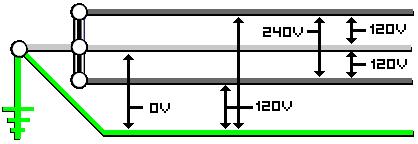
  • 120/240 V, Three wire – single phase system (as per NEC code) (fig.2)
fig.1

fig.2

Q4: what are the electrical systems Configurations for a three phase system?
  • 120/208V or 220/380V or 220/400V or 230/415V or 277/480V or 347/600V, Four Wire-three phase system Wye.(fig.3)
  • 120/240V, Four Wire-three phase system Delta (high Leg).(fig.4)
  • 220V or 240V, Three Wire-three phase system Delta (corner ground).(fig.5)


fig.3
fig.4
fig.5

Q5: What is the difference between a series circuit and a parallel circuit?
 A series circuit has one path; the parallel circuit splits into branches

Q6: what is the definition of Apparent power (S)?
Apparent power is the product of the current and voltage of the circuit. Due to energy stored in the load and returned to the source, or due to a non-linear load that distorts the wave shape of the current drawn from the source.

Q7: what is the definition of Real power (P)?
Real power is the capacity of the circuit for performing work in a particular time

Q8: what is the difference between the Real power (P) and Reactive power (Q)?
Reactive power does not transfer energy, so it is represented as the imaginary axis of the vector diagram. Real power moves energy, so it is the real axis.

Engineers care about apparent power, because even though the current associated with reactive power does no work at the load, it heats the wires, wasting energy.

Q9: what are the unit measurements for Apparent power(S), Real power (P) and Reactive power (Q)?
Unit for Apparent power(S) is VA (volt ampere)

Unit for Real power (P) is W (watt)

Unit for Reactive power (Q) is VAR (volt ampere reactive)

Q10: what is the phase difference Angle?
Phase difference angle (φ), the angle of difference (in degrees) between voltage and current; Current lagging Voltage (Quadrant I Vector), Current leading voltage (Quadrant IV Vector)


Q11: What is the power factor?
The power factor of an AC electric power system is defined as the ratio of the real power flowing to the load to the apparent power in the circuit

Q12: what is the value range of the power factor?
The power factor is a dimensionless number ranging between 0 and 1

It is zero when the current leads or lags the voltage by 90 degrees.

Q13: Can we add the real power (P) of different loads to get the total load for them?
No, we can’t .we must be sure that the phase difference is the same for all these loads

Q14: Can we add the Apparent power (S) of different loads to get the total load for them?
Yes, we can sum the complex values of the Apparent power for these Loads.

Q15: when the current lead the voltage?
Purely capacitive circuits cause reactive power with the current waveform leading the voltage wave by 90 degrees

Q16: when the current lag the voltage?
while purely inductive circuits cause reactive power with the current waveform lagging the voltage waveform by 90 degrees.

Q17: why the inductors cause the lagging of current?
When a voltage is initially placed across the coil a magnetic field builds up, and it takes a period of time for the current to reach full value. This causes the current to lag the voltage in phase, and hence these devices are said to absorb reactive power.

Q18: why the capacitors cause the lagging of voltage?
When current is driven through the capacitor, it takes a period of time for charge to build up to produce the full voltage difference.

Q19: what is the relation between for Apparent power(S), Real power (P) and Reactive power (Q)?


S = P + jQ


Beginners' design course:Electrical System Configurations


Typical Electrical System Configurations :
  • 2-Wire, Single Phase (Outside U.S.).
  • 3-Wire Single-Phase.
  • 3-Wire 3-Phase Delta (Corner Ground).
  • 4-Wire 3-Phase "Wye".
  • 4-Wire, 3-Phase Delta (High Leg).
2-Wire, Single-Phase System see fig.1
this system is applied Outside of the United States, a variety of voltages used in this system configuration according to the standard applied in each country.
This system is different from the US "Edison System" in that only one voltage is available 

fig.1

Example

Single Phase 240V (see fig.2)
fig.2


3-Wire, Single-Phase System see fig.3
The 3-wire, single-phase Edison system is the only approved method of wiring single­phase systems in the United States.it has two voltages available one 120V and the second is 240V.
fig.3

Example
Single Phase 120/240V (see fig.4)

fig.4

3-Wire, Three-Phase Delta System (Corner Ground) see fig.5This system configuration is the simplest one , it normally used in the transmission of intermediate voltages from 15,000V to 600V where the neutral conductor is not used. It is also used in industrial facilities by grounding one "corner" of the System. 
The corner-grounded Delta system minimize the wiring costs, and the grounded phase can be used to physically protect the other two phases from accidental grounding or lightning strikes in outdoor settings. 
The disadvantage of this system is inability for distributing power to single phase loads. 
fig.5

Example:
  • 220 Volt Corner Ground (see fig.6)
  • 440 Volt Corner Ground (see fig.7)
fig.6

fig.7

4-Wire, Three-Phase "Wye" System see fig.8it is the most common electrical system configuration, the ground voltage or voltage available from phase to ground is the phase voltage divided by 1.73
As with all other grounded systems, bonds are established between the grounded neutral and all components of the system. This system is recognized as the safest possible multi-purpose distribution system for low voltage (in the United States). Outside the United States, common voltages are 215v/380, 220v/400v, and 230v/415v. 
fig.8

Lighting Calculations Spreadsheets


1- GE Fixture Count Estimator see fig.1

Estimate number of fixtures needed to light an indoor area to a specified light level (foot-candle level).
You need to Click on the first green cell and tab to the other input cells. 


fig.1

To download, GE Fixture Count Estimator, please Click Here


2- Siemens Lighting Calculator see fig.2


this calculator give quick results by using the Room cavity method for lighting calculations.just follow the instructions page and you will get a reliable results.


fig.2

To download, Siemens Lighting Calculatorplease Click Here

Sound System Course: Audio Amplifier

fig.1

Audio Amplifier (Boosters):
see fig.1
An audio amplifier is an electronic amplifier that amplifies low-power audio signals (signals composed primarily of frequencies between 20 - 20 000 Hz, the human range of hearing) to a level suitable for driving loudspeakers and is the final stage in a typical audio playback chain.
While the input signal to an audio amplifier may measure only a few hundred microwatts, its output may be tens, hundreds, or thousands of watts.                                                                                                   

And to understand what is an Audio Power is, we need to go through the following definitions:

1- Gain The gain of an amplifier is the ratio of output to input power or amplitude, and is usually measured in decibels.
amplifiers are often specified in terms of the maximum power gain obtainable, while the voltage gain of audio amplifiers and instrumentation amplifiers will be more often specified (since the amplifier's input impedance will often be much higher than the source impedance, and the load impedance higher than the amplifier's output impedance).
The gain of a good quality full-range audio amplifier will be essentially flat between 20 Hz to about 20 kHz (the range of normal human hearing).

2- Bandwidth The bandwidth of an amplifier is the range of frequencies for which the amplifier gives satisfactory performance.

3- Efficiency Efficiency is a measure of how much of the power source is usefully applied to the amplifier's output.

4- Clipping When the signal drive to the amplifier is increased, the output also increases until a point is reached where some part of the amplifier becomes saturated and cannot produce any more output; this is called clipping, and results in distortion.

5- Noise This is a measure of how much noise is introduced in the amplification process.

6- Output dynamic range It is the range, usually given in dB, between the smallest and largest useful output levels. The lowest useful level is limited by output noise, while the largest is limited most often by distortion. The ratio of these two is quoted as the amplifier dynamic range.

if S = maximal allowed signal power and N = noise power, the dynamic range DR is:
DR = (S + N ) /N

7- Slew rate It is the maximum rate of change of the output, usually quoted in volts per second (or microsecond). Many amplifiers are ultimately slew rate limited.

8- Stability It is an issue in all amplifiers with feedback, whether that feedback is added intentionally or results unintentionally. It is especially an issue when applied over multiple amplifying stages.

9- Negative feedback It occurs when the output of a system acts to oppose changes to the input of the system, with the result that the changes are attenuated. If the overall feedback of the system is negative, then the system will tend to be stable.

10- Distortion It is the alteration of the original shape (or other characteristic) of sound wave. Distortion is usually unwanted, and often many methods are employed to minimize it in practice.
Audio Amplifier Applications: 
  • Public address systems.
  • Theatrical and concert sound reinforcement.
  • Domestic sound systems. 
  • The sound card in a personal computer.

What are the types of Audio Amplifiers? 
  • Tube Amplifiers.
  • FET Amplifiers.
  • Transistors Amplifiers.
  • Class A, Class AB, Class B Amplifiers.
  • Class D Amplifiers.
  • Stereo, Monoblock, and Multichannel Amplifiers.
1- Tube Amplifiers see fig.2
Tube amplifiers use vacuum tubes to convert the AC signal to a DC current that can power speakers. Combinations of multiple tubes increase the overall gain of the signal. Higher powered tube amps often use a pentode circuit design, while lower powered tube amps use a single ended triode (SET) design. SET amps are very popular with people who have high efficiency speakers (typically horns). 

fig.2

2- FET Amplifiers see fig.3A FET (Field Effect Transistor) is a solid state design amp. Solid state amps run much cooler than tube amps (which create a lot of heat from the output tubes). A MOSFET (Metal Oxide Semiconductor Field Effect Transistor) is probably the most popular solid state amplifier design. MOSFETs can create very high gain amplifiers.
fig.3

Generator Manufacturers List - Cummins


Cummins Main ProductsCummins complementary business units design, manufacture, distribute and service engines and related technologies, including fuel systems, controls, air handling, filtration, emission solutions and electrical power generation systems.

and here we will explain only the last product which is the power generation systems manufactured by Cummins Power Generation Inc.

Cummins Power Generation Inc. Product Lines which includes:
1- Cummins Power Generation.
2- Cummins Onan.
3- Cummins Generator Technologies.
4- Cummins G-Drive.

we will begin with the Power Generation Products which include:
A- Generator Sets.
B- Automatic Transfer Switches.
C- Paralleling Equipment and Switchgear.
D- Networks.
E- Accessories.


first: the Generator Set Products which include:
a- Diesel engine generator sets in the 7 kW to 2.7 MW range.
b- Spark–ignited natural gas/propane engine generators in the 7 kW to 150 kW range.
c- Lean–burn gas engine generators in the 315 kW to 2 MW range.
d- Rental Power Generators
e- DC Generators

a- Diesel Generator Sets (see fig.1)
Cummins diesel–powered generator sets are available in sizes ranging from 10kW to 2.5 MW. These clean, modern diesels with optional exhaust aftertreatment are suitable for either standby/emergency power, continuous or prime power applications. 

fig.1

b-Spark–Ignited Gas Generator Sets (see fig.2)spark–ignited (stoichiometric) natural gas/propane engine generator sets are available in sizes ranging from 5 kW to 150 kW. These are suited to mid–size applications where onsite fuel storage is restricted, a continuous supply of natural gas is readily available or there are local environmental considerations. 

fig.2

c- Lean–Burn Gas Generator Sets (see fig.3)Cummins lean–burn natural gas engine generator sets are available in sizes ranging from 315kW to 2 MW. These feature very low emissions and are suitable for prime power and combined heat and power (CHP) applications. Low BTU fuel option on specific models.
fig.3

d- Rental Power Generators (see fig.4)
A new line of Rental Power units designed specifically for rental power applications are now for sale in sizes from 60 kW to 1000 kW.

fig.4

Transformer Procurement Course - Transformer Windings


What is a Transformer winding? 

Generally, the windings are coils wound around a ferromagnetic core.

What are the materials used for winding coils? 

Coils material used for the windings depends upon the application as follows:

1- For small power and signal transformers, in which currents are low and the potential difference between adjacent turns is small, the coils are often wound from enameled magnet wire

2- Larger power transformers operating at high voltages may be wound with copper rectangular strip conductors insulated by oil-impregnated paper or other insulating materials

3- High-frequency transformers operating in the tens to hundreds of kilohertz often have windings made of braided Litz wire to minimize the skin-effect and proximity effect losses

What are the types of Transformer windings? 

  • Layer windings (see fig.1)
  • Helical windings (see fig.2)
  • Disc windings (see fig.3)
  • Foil windings (see fig.4)


How to select the transformer winding type? 
The selection will be based on some factors like:

  • The required number of turns 
  • The required current Value in the winding primary 
fig.1

What is the Layer winding? 
(See fig.1)

The Turns of Layer winding are arranged axially along the winding and wound close to each other without any intermediate space. The Winding may be made as a single or multi-layers winding and it can be used as regulating windings for large transformer.
fig.2


What is the helical winding? 
(See fig.2 )

Helical Winding is made as multi-layer windings with spaces between each turn/layer and other in the winding,

Helical Winding is used for high current transformer although it has a high space Factor which gives a big size transformer but it is mechanically robust and easy to manufacture. 

fig.3

What is Disc winding? 
(See fig.3)

Disc winding type is build up from a number of Discs connected in series, in each disc; many turns are wound in radial direction.

Disc winding type is used for transformer having large number of turns and relatively small currents and highest voltage windings.

A special type from this winding called the double disc winding is used for highest current transformer (100 KA) as in the furnace transformers and rectifier transformers for industrial applications. 

Electrical Drawing Details - main


Note: Please, Click on the Drawing Details Group Name to open its contents.


This group will contain drawing details such as Schedule of pull/junction boxes and lighting outlets back boxes, Standard mounting details of distribution board, MICC/PVC cable system fixed on the soffit of RCC roof beam, Details for cable termination in MV panel, MICC/PVC cable system passing through the expansion joint and more.


This group will contain drawing details such as Cable tray crossing expansion joint, Standard mounting details for electrical light fitting, Transition cable tray to conduit, mounting arrangement for recessed light fixtures, Section detail for cable tray and AC duct and more.


This group will contain drawing details such as Highbay light mounting detail, MICC in conduit mounting detail, Surface mounting lighting fixture detail, NEC 820-40(a) thru (d), Connection to room grounding bus, Recessed mounted luminaries, Transition cable tray to conduit and more.


This group will contain drawing details such as down conductor (structural column), Grounding system for computer room, Grounding schematic diagram, Ground electrode assembly, Earth test point, Football ground/parade area flood light fixture mounting detail (elevation) and more.


This group will contain drawing details such as Roof penetration drawing detail , Lightning riser to roof drawing detail, Power supply to roof mounted exhaust fan drawing detail, Lighting pole base foundation drawing detail, Swimming pool lighting fixture drawing detail and more.


This group will contain drawing details such as Lighting pole base detail, Lightning protection arrangement detail, Sound system riser diagram detail, Socket outlet installation (insulated wall) detail, Air terminal detail, Connection to room grounding bus detail and more.


This group will contain drawing details such as Trunking System Arrangement Drawing Detail, Earth rod Drawing Detail, Cable To Earth rod Connection (Thermo weld) Drawing Detail, Connection Of Earth Pit To Reinforcement At Ground Level Drawing Detail, Tee Connection (T) & Cross Bonding Connection (CBC) Drawing Detail, Steel Rebar To Cable Connecting Pont (RB) Drawing Detail, Typical Details Of Earthing Cable To Steel Bar Connection Drawing Detail and more.


Electrical Drawing Details - Group no.(2)


Electrical Drawing Details - Group #2

  • Cable tray crossing expansion joint.

  • Standard mounting details for electrical light fitting.

  • Transition cable tray to conduit.

  • Mounting arrangement for recessed light fixtures.

  • Section detail for cable tray and AC duct.

  • Down conductor details.

  • Mounted detail of isolator on floor plan.

  • Swimming pool ground bonding detail.

  • Ground electrode assembly #1.

  • Ground electrode assembly #2.

  • Sectional elevation – communication and security.

  • Sectional elevation for low voltage cable tray.

  • Mounting arrangement for recessed lighting fixtures.


  • Electrical installation detail #1.

  • Electrical installation detail #2.

  • Triangular counterpoise grounding arrangement.

  • Earth system detail.

  • Cable tray support.

  • Typical lightning conductor installation.

  • Cable termination at fuse box.


to download Electrical Drawing Details - Group #2, click here or  here


Tender Documents Preparation - Statement of Work SOW


Statement of Work (SOW):

What is a Statement of Work SOW?

Generally, it is a document which states the works to be done, execution time line, pricing in detailed and deliverables in spot of general / special terms and conditions.

Notes: 
1- Every contracting company, consulting office or governmental authority has its own SOW document which will be different in formats and styles from others.

2- SOW will be considered as a binding contract after approval from all parties but it can be modified later after agreement of all Contract Parties.

How to writ a SMART SOW?

To write a SMART SOW we must know the SMART structure for it, The SMART format of SOW will include the following sections:
1- Title
this section identifies the name of the project, project’s main requirements and contracting mechanism.

2-Background 
this section provide information about the owner and his needed goals for the project.

3-Objective 
this section clarify the owner’s goals from the tendering process and clarify the permissible number of contractors (one or multi) who will win this tender and clarify also the required type of Contractor; consists of a firm or an individual providing services, or both.

4-Estimated value 
this section provides guidance for total tender value to the Bidders. This value may be a fixed value or estimated high / low ranges or amount not to exceed value.

5-Definitions and applicable documents 
this section provides interpretation of the terminology and documents included in the tender to prevent misunderstanding of tender requirements.

6-Business and/or technical environment 
this section identify operational requirements of the work (e.g. normal working hours) and infrastructure with which the Contractor will be required to work in the Contract stage.

7-Description and scope of work 
this section provides guidance to assist Bidders in understanding the work to be undertaken and provide clarity in developing their Proposals.

8-Deliverables 
this section clearly identifies the products or outcomes that the Contractor is required to produce in order to receive payment.

9-Contractor resource requirements & qualifications 
this section identify the skills of contractor stuff and an approximate division of labour for activities associated with each of the Contractor’s resources for the completion of the work.

10-Approach and methodology 
How to Write a Statement of Workthis section describes how the Contractor will specifically go about the completion of the work under the resulting contract but note that The Contractor is required to provide its own specific methodology for the completion of the tasks and deliverables.

11-Performance standards and quality assurance 
this section identifies the owner’s expectations for the outcome of the work, or, the level of performance required from the Contractor.