Electrical Water Heaters Power Rating Calculations – Part Two


This is the second Article for helping designers to choose the appropriate type and calculate the required power rating for the chosen type of Electrical Water Heater.


In the first Article " Electrical Water Heaters Power Rating Calculations – Part One", we gave you a brief about the following points:


  • Hot Water System Components,
  • Different types of Water Heaters used in domestic and commercial buildings,
  • How to choose the best type of water heater for any application?


With this brief, you will be familiar with the types and construction of common Water Heaters.

Today, we will explain in detail the Sizing and Power Rating Calculations for Water Heaters.


1-      Design Methodology of Electrical Water Heaters for any Building


First let's start from the beginning, you are the electrical designer for a new building and you want to size and calculate the power rating for the electrical water heaters that will be used through this building, so what is the first information that you must know?

  • Yes, it is the type of this building/ occupancy, is it a residential, business, hospital, hotel, office building … etc?
  • The second information that you must know or calculate is the number of plumbing facilities in this building; this means how many Water Closets WCs, Lavatories, Bathtubs, showers, drinking fountains and service sinks included in this building.
  • The third information that you must calculate is the total demand of water (in gallons or liters) used per hour or minute in units of GPH (gallon per hour) or GPM (gallon per minute), this can be done by using the standard tables of GPH or GPM for each type of plumbing facilities for each type of buildings provided by many international or local plumbing codes.
  • At the end, by following one of the calculation procedures explained in this course, you can calculate the size (volume) in gallons or liters and the power rating in KW for the required electrical water heaters for this building.

Design Methodology of Electrical Water Heaters for any Building


Fig (1): Design Methodology of Electrical Water Heaters for any Building


As a summary for the above design methodology which is represented in Fig.1, we are going to calculate the following:

  • The Minimum number of plumbing facilities for a given type of building/occupancy,
  • The total demand of Water in GPH or GPM,
  • The size (volume) in gallons or liters for the required electrical water heaters,
  • The power rating in KW for the required electrical water heaters.


Step#1: Determination of The Building/Occupancy Type


As we all know that there are different types of buildings/occupancies which they are differentiated as per their main usage to the following main categories:

  1. Industrial buildings,
  2. Commercial buildings,
  3. Residential buildings,
  4. Agricultural buildings,
  5. Educational buildings,
  6. Transportation buildings,
  7. Religious buildings,
  8. Parking and storage,
  9. Military buildings,
  10. Governmental buildings,
  11. Cultural buildings,
  12. Other buildings.


For more information about the above types of buildings, please read our article " Electrical Design Philosophy for Major Types of Buildings ".


Step#2:  Calculation of The Minimum Number of Plumbing Facilities for a Given Type of Building/Occupancy


The common Plumbing Facilities for included in any Type of the above Buildings are as follows:

  1. Water Closets WCs,
  2. Lavatories,
  3. Bathtubs, 
  4. Showers, 
  5. Drinking fountains,
  6. Service sinks,
  7. Water coolers,
  8. Water dispensers,
  9. Dishwashers,
  10. Laundries.


And to know the Minimum Number of Plumbing Facilities for a Given Type of Building/Occupancy, you must use one of the two following methods:

  1. Quantity survey,
  2. Calculation by using Excel Spreadsheets.


1- Quantity survey:
In this method to get the number of Plumbing Facilities, A quantity survey will be done from the architectural drawings of the new constructed buildings or by a site visit for the existing/old buildings.


2- Calculation by using Excel sheets:
This method will be used only in two cases:

  • Case#1: Where you can't get the architectural drawings of the new constructed building or,
  • Case#2: In the preliminary design phase where preliminary electrical load calculations have to be done, In this case, we can Calculations Spreadsheet for Minimum Number of Plumbing Facilities Required as per International Plumbing Code (IPC).


Calculations Spreadsheet For Minimum Number Of Plumbing Facilities Required


The standard data used in this excel sheet are from International Plumbing Code (IPC) that developed by the International Code Council (ICC).

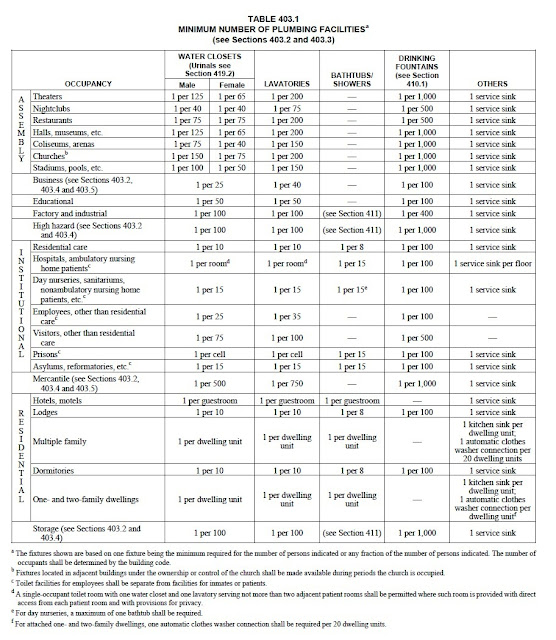
This Excel Spreadsheet uses IPC - Table 403.1 for Minimum Number of Fixtures Required (see Fig.2). The table specifying the minimum number of plumbing fixtures required based on the following factors:

  • The Building Occupancy Type,
  • The Occupancy Classification,
  • The Number of Building Occupants.

Minimum Number of Fixtures Required (Table 403.1)


Fig (2): Minimum Number of Fixtures Required (Table 403.1)


Advantages of using IPC - Table 403.1 for Minimum Number of Fixtures Required:

  • The IPC - Table 403.1 is based on various studies and is intended to provide equal access to fixtures,
  • The IPC - Table 403.1 is very accurate since it is directly related to the referenced building codes,
  • The IPC - Table 403.1 takes into consideration the female population and the waiting period for the female population.


How to use the Calculations Spreadsheet for Minimum Number of Plumbing Facilities Required?


This excel sheet includes (4) sheets as follows:

  1. Cover and General data sheet,
  2. Floor input data sheet,
  3. Floor Calculation results sheet,
  4. Standard data sheet.


1- Cover and General Data Sheet
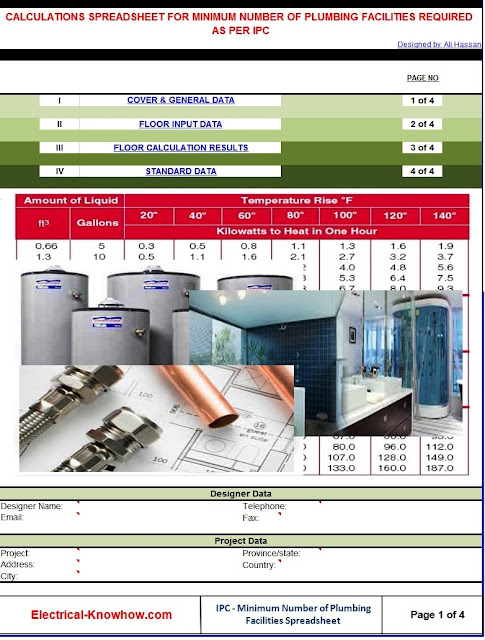


Cover and General data sheet

Fig (3): Cover and General data sheet


  • This worksheet lists the other worksheets in an index as shown in above Fig.3 ; you can go to a specific worksheet by just clicking on its name.
  • You can email me directly by clicking on the phrase “Designed by: Ali Hassan” for any inquiries or notes. 
  • This worksheet includes also the general data about the project and the designer which must be filled for every new project designed by this excel sheet. 


2- Floor Input Data Sheet


Floor input data sheet

Fig (4): Floor input data sheet


In this sheet (see Fig.4), you must Input the following data:


a- Floor Level: input Floor level,

b- The Building Occupancy Type: Pick Building Classification from the dropdown menu which includes (4) nos. of basic types of Building Occupancy as follows:


  1. Business,
  2. Assembly,
  3. Institutional,
  4. Residential.


c- The Occupancy Classification: Pick Occupancy type from the dropdown menu which includes (26) nos. of Classifications of Occupancies as follows:


Theaters
Factory & Industrial
Asylums, reformatories, Etc
Nightclubs
High Hazard (See Section 403.2 & 403.3)
Mercantile (See Section 403.2, 403.3 & 403.5)
Restaurants
Residential Care
Hotels, Motels
Halls, Museums, Etc.
Hospitals
Lodges
Coliseums, Arenas
Ambulatory Nursing Home Patients
Multiple family
Churches
Day Nurseries, Sanitariums, Nonambulatory Nursing Home Patients, Etc.
Dormitories
Stadiums, Pools, Etc.
Employees, other than Residential care
One & Two family Dwellings
Business (See Section 403.2, 403.3 & 403.5)
Visitors, other than Residential care
Storage (see Sections 403.2 & 403.4)
Educational
Prisons


d- The Area of the building in square footage (floor wise): Input square footage for floor under design.

Note: If the input cell is shaded in grey, so no input required.


e- The Number of Building Occupants: Input number of people planned to use this floor.

Note: If the input cell is shaded in grey, so no input required.


f- Number of Cells in Housing Pod: Input number of cells within housing pod. Program assumes that cells are double bunked.

Note: If the input cell is shaded in grey, so no input required.


g- Percentage of Males and Females: The required number of fixtures shall be distributed equally between the sexes based on the percentage of each sex anticipated load. The occupant load shall be composed of 50% of each sex, unless statistical data approved by the code official indicate a different distribution of the sexes. This condition will not occur in prisons or other similar type facilities.


3- Floor Calculation Results Sheet


Floor Calculation results sheet


Fig (5): Floor Calculation results sheet


In this sheet (see Fig.5), the calculation of Minimum Number of Fixtures Required for the floor under design will be done, you will find the following results:

  1. Percentage of Males,
  2. Percentage of Females,
  3. Total number of people,
  4. Number of men,
  5. Number of women.

Details of calculated plumbing Facilities Required as follows:


  1. Water closets,
  2. Urinals,
  3. Lavatories,
  4. Bathtubs/Showers, 
  5. Drinking fountains,
  6. Service sinks.

In bottom of this sheet, you will find the Totals of Calculated Plumbing Facilities Required for Floor under design.

Note:
  • You must repeat the calculation for each floor to get the total Number of Plumbing Facilities Required for it. These results will be used to calculate the total demand of Water in GPH or GPM for the building floor under design.


4- Standard Data Sheet


Standard data sheet

Fig (6): Standard data sheet


This sheet (see Fig.6) includes the standard values of IPC - Table 403.1 for Minimum Number of Plumbing Facilities required based on the factors described above.


To download your copy of Calculations Spreadsheet for Minimum Number of Plumbing Facilities Required as per IPC code, please click on the link.


Note:
Non-registered members in Electrical-Knowhow website will not be able to open and use this excel spreadsheet.


To register as a member of Electrical-Knowhow website, please do the following:


  1. Click on the phrase “Join this site" in bottom of the home page, above the images of our members (see above image). 
  2. After finishing your registration send email to ali1973hassan@yahoo.com, asking for your password and I will send it with email reply. 


Notes for downloading our files:
  1. click on the file name that you want to download, 
  2. a new page will open, don't care about the message "these files are temporary unavailable", 
  3. Look in the upper right corner of the page, you will find an arrow point to down, 
  4. Click this arrow the download will start automatically, 
  5. After downloading, you will need to enter your password again to open the file.


In the next Article, I will explain in detail the last (3) steps of Design Methodology for Electrical Water Heaters for any Building which are:

  • Step#3: Calculation of the total demand of water in GPH or GPM,
  • Step#4: Calculation of the size (volume) of the required Electrical Water Heaters in gallons or liters, 
  • Step#5: Calculation of the power rating in KW for the required Electrical water heaters.

So, please keep following.


Electrical Water Heaters Power Rating Calculations – Part One


Most Domestic and commercial buildings need a service hot water system. Depending upon the type of building, this system could range from as small as an under sink water heater for washing hands to a 10,000 gallon hot water storage tank system used in a hospital laundry.


This Article is intended to help designers to choose the appropriate type and calculate the required power rating for thee chosen type of Electrical Water Heater.

Before going on with the calculations, we need to give you a brief about the following points:

  • Hot Water System Components,
  • Different types of Water Heaters used in domestic and commercial buildings,
  • How to choose the best type of water heater for any application?

With this brief, you will be familiar with the types and construction of common Water Heaters.


1-      Hot Water System Components


A Hot water heating system has (4) major components (see Fig.1):

  1. Heat energy source,
  2. Heat transfer equipment,
  3. Distribution system,
  4. Terminal hot water usage devices.


Hot Water System Components


Fig (1): Hot Water System Components

The most important components are the first and second ones.


1.A- Heat energy sources, they may be:

  1. Fuel combustion,
  2. Solar energy collection,
  3. Electrical conversion,
  4. Recovered waste heat.


1.B- Heat transfer equipment, they may be:

Direct heat transfer (see Fig.2) is from the combustion of fuels or direct conversion of electrical energy into heat,


Direct Water heater


Fig (2): Direct Heat Transfer

Indirect heat transfer (see Fig.3) uses heat energy originating from remote heat sources, such as boilers, solar heat collectors, cogeneration refrigeration or waste heat.


Indirect water Heater


Fig (3): Indirect Heat Transfer


2- Types of Water Heaters in Domestic And Commercial Buildings


Common types of commercial and industrial water heating equipment include:

  1. Storage water Heaters (Tank-Type),
  2. Instantaneous water heaters (Tankless-Type),
  3. Hybrid water heaters.


2.1- Storage Water Heaters (Tank-Type)

This type of heaters incorporates the burner, storage tank, outer jacket, insulation and controls in a single unit and is normally installed without dependence on other hot water storage equipment (see Fig.4).

Typical Storage Water Heater


Fig (4): Typical Storage Water Heater (Tank-Type).

They are available in electric, liquid propane (LP) and natural gas models. Natural gas and LP water heaters normally use less energy and are less expensive to operate than electric models of the same size.

There are two types of Storage water heaters (Tank-Type) which are:

  1. Volume Storage water heaters (Tank-Type),
  2. Small Storage water heaters (Tank-Type).


2.1.A Volume Storage Water Heaters (Tank-Type)

They are typically vertical, cylindrical tanks, usually standing on the floor or on a platform raised a short distance above the floor (as in Fig.4). In houses they can be mounted in the ceiling space over laundry-utility rooms. Typical sizes for household use range from 75 to 400 liters (20 to 100 US gallons).


2.1.B Small Storage Water Heaters (Tank-Type)

Small storage tank water heaters, known as point of use (POU), utility or mobile home water heaters, are good choices for adding hot water to small buildings, shops or garages (see fig.5).


Small Storage Water Heaters


Fig (5): Small Storage Water Heaters (Tank-Type)

These water heaters usually range in size from 2.5 to 19 gallons. The largest of these miniature units can also be used to provide hot water to secondary bathrooms that may be situated far from your home's main water heater.

Tiny point-of-use (POU) electric storage water heaters with capacities ranging from 8 to 32 liters (2 to 6 gallons) are made for installation in kitchen and bath cabinets or on the wall above a sink. They typically use low power heating elements, about 1 kW to 1.5 kW, and can provide hot water long enough for hand washing, or, if plumbed into an existing hot water line, until hot water arrives from a remote high capacity water heater.


Storage water heaters (Tank-Type) have a special type which is the Solar water heaters.


2.1.C Solar Water Heaters

Solar powered water heaters have two main components (see Fig.6):

  1. Solar collectors,
  2. Storage tank.


Fig (6): Solar Water Heater Components


1- Solar Collectors
Solar collectors are installed outside dwellings, typically on the roof or walls or nearby,

2- Storage Tank
The potable hot water storage tank is typically a pre-existing or new conventional water heater, or a water heater specifically designed for solar thermal.


Types Of Solar Water Heaters

Solar powered water heaters have two main types:

  1. The direct-gain type,
  2. The Indirect or closed-loop type.


A- The Direct-Gain Type:

In this type (see Fig.7), the potable water is directly sent into the collector. Many such systems are said to use integrated collector storage (ICS), as direct-gain systems typically have storage integrated within the collector.


Direct-Gain Solar Water Heater


Fig (7): Direct-Gain Solar Water Heater

Heating water directly is inherently more efficient than heating it indirectly via heat exchangers, but such systems offer very limited freeze protection (if any), can easily heat water to temperatures unsafe for domestic use, and ICS systems suffer from severe heat loss on cold nights and cold, cloudy days.


B- The Indirect Or Closed-Loop Type:

This type does not allow potable water through the panels, but rather pump a heat transfer fluid (either water or a water/antifreeze mix) through the panels (see Fig.8). After collecting heat in the panels, the heat transfer fluid flows through a heat exchanger, transferring its heat to the potable hot water.


Closed-Loop Solar Water Heater

Fig (8): Closed-Loop Solar Water Heater

When the panels are cooler than the storage tank or when the storage tank has already reached its maximum temperature, the controller in closed-loop systems will stop the circulation pumps.


2.2- Instantaneous Water Heaters (Tankless-Type)

They can called also on-demand water heaters, this type of heaters has minimal storage capacity, they do not store hot water; rather they Heat water as it passes through a series of coils in the unit (see Fig.9). They are available in electric, LP and natural gas models. Most tankless units can provide up to 3.5 gallons of heated water per minute.


Instantaneous Water Heaters (Tankless-Type)


Fig (9): Instantaneous Water Heaters (Tankless-Type)


They usually include a flow switch as part of the control system. Tankless, instantaneous water heaters are best used for a steady, continuous supply of hot water. Tankless heaters may be installed throughout a household at more than one point-of-use (POU), far from a central water heater, or larger centralized models may still be used to provide all the hot water requirements for an entire house.

The main advantages of tankless water heaters are:

  1. A continuous flow of hot water as compared to a limited flow of continuously heated hot water from conventional tank water heaters,
  2. Since the unit only heats water as you use it, a tankless heater is usually more energy efficient than a traditional storage tank water heater.


The main disadvantages of tankless water heaters are:

  1. Tankless water heaters can provide an unlimited amount of hot water, but it can only provide a limited number of POU,
  2. Common types of water heaters can't supply hot water at more than two points at a time.


A famous type of Instantaneous water heaters (Tankless-Type) is Electric shower heads

2.2.A Electric Shower Heads

An electric heating element is incorporated into such shower heads to instantly heat the water as it flows through (see Fig.10).

Electric Shower Heads


Fig (10): Electric Shower Heads

Electric showers have a simple electric system, working like a coffee maker, but with a larger water flow. A flow switch turns on the device when water flows through it. Once the water is stopped, the device turns off automatically. An ordinary electric shower often has three heat settings: low (2.5 kW), high (5.5 kW) or cold (0 W) to use when a central heater system is available or in hot seasons.


2.3 Hybrid Water Heaters

A hybrid water heater (see Fig.11) is a water heating system that integrates technology traits from both the tank-type water heaters and the tankless water heaters. It Heats cold water via an electrical heating element and heat pump that pulls in ambient air and extracts the available heat.


Hybrid Water Heaters


Fig (11): Hybrid Water Heaters


They are also called Heat Pump Water Heaters (HPWH), they have small storage tanks that temper incoming cold water; This means hybrids only have to increase water temperature from warm to hot as opposed to tankless which has to raise completely cold water to hot. The defining characteristics of a "hybrid water heater" are:

  1. A combination of water flow of tank and efficiency of tankless of water heater,
  2. Built-in small storage water reservoir as part of heat exchanger (typically between two gallons to 20 gallons),
  3. Dual activation: flow sensing and thermostat control.


Hybrid water heaters can be gas-fired (natural gas or propane), or be electrically powered using a combination of heat pump and conventional electric heating element.


3- How to choose the best type of water heater?


Many factors determine which water heater is best for your home. The three main factors to consider when choosing your water heater are:
 
  1. Water Storage Capacity,
  2. Water Heating Method,
  3. water heating system structure,
  4. water heating system Fuel Type,
  5. Recovery Rate,
  6. Space Limitations,
  7. Energy Efficiency.


3.1 Water Storage Capacity (by gallons or liters)

An undersized water heater will work harder and have a shorter lifespan.  So make sure to select a hot water heater that provides enough hot water for your home. The typical capacities for different types of water heaters are as follows:

  • Volume Storage water heaters (Tank-Type): Typical sizes for household use range from 75 to 400 litres (20 to 100 US gallons).
  • Small Storage water heaters (Tank-Type:  range in size from 2.5 to 19 gallons.
  • Tiny point-of-use (POU) electric storage water heaters with capacities ranging from 8 to 32 liters (2 to 6 gallons).
  • Instantaneous water heaters (Tankless-Type): Most tankless units can provide up to 3.5 gallons of heated water per minute.
  • Hybrid water heaters: Typical sizes between two gallons to 20 gallons.


3.2 Water Heating Method

According to the user requirements, the selected method of water heating method can be determined as follows:
  1. Storage water Heaters (Tank-Type),
  2. Instantaneous water heaters (Tankless-Type),
  3. Hybrid water heaters.


Each offers unique advantages, and you can compare features and benefits in the table below.


Type
Method of operation
Factors to be Considered
Conventional Tank
Stores hot water regularly in a tank sized to suit the users requirements.
  • Economical,
  • Can be positioned in closet, basement or garage
  • Capacity ranges from 20 to 100 gallons,
  • Efficiency varies between models, brands and 
  • fuel sources.


Tankless
They do not store hot water; rather they Heat water as it passes through a series of coils in the water heater.
  • Require a larger up-front investment,
  • best used for a steady, continuous supply of hot water,
  • A continuous flow of hot water,
  • Hang on wall and frees up floor space,
  • Excellent option for residences occupied part-time,
  • usually more energy efficient by as much as 30%,
  • can provide an unlimited amount of hot water, but for only limited number of POU,
  • Requires ventilation.


Hybrid
Heats cold water via an electrical heating element and heat pump that pulls in ambient air and extracts the available heat.
  • Require a larger up-front investment,
  • Magnesium anode rod extends life of the tank,
  • Heat pump delivers more hot water, up to 33 percent faster than standard electric water heater.


3.3 Water Heating System Structure

Also, according to the user requirements, the structure or distribution of hot water system can be one of the following types:

  1. Centralized (Whole House) system,
  2. Point of Use Systems.


Each type is explained in detail in above paragraphs.


3.4 Water Heating System Fuel Type

As per the user requirements, the selected fuel for the water heating system can be one of the following:

  1. Natural gas,
  2. LP (liquid propane gas),
  3. Electric,
  4. Solar.


Most water heaters are fueled by gas or electricity. Refer to the table below for comparison:

Type
Factors to be Considered
Gas
  • Requires a slightly larger up-front investment,
  • Must be vented outdoors for safety,
  • Units with sealed combustion or power venting increase safety,
  • Cost less to operate,
  • Not affected by power outages (tank-style only).

Electric
  • Generally cost less than gas models,
  • Easy to maintain,
  • Requires no combustibles or venting,
  • Heats water quickly,
  • Offer high energy factor ratings.

Hybrid (electric)
  • Requires a larger up-front investment,
  • Requires no combustibles or venting,
  • Heats water up to 33 percent quicker than standard electric models,
  • Lower operating costs saves hundreds annually,
  • 8700 BTU/h compressor is the most powerful in its class.

Liquid Propane (gas)
  • Requires a slightly larger up-front investment,
  • Must be vented outdoors for safety,
  • Units with sealed combustion or power venting increase safety,
  • Cost less to operate than electric models,
  • Not affected by power outages (tank-style only).

Solar Power
  • relatively good payback period, in average between 5-10 years,
  • low maintenance costs,
  • relatively high upfront costs,
  • in most areas they will require electrical or gas or other fuel backup during the winter period,
  • they require excellent overheating and freeze protection,
  • Environment friendly.


3.5 Recovery Rate
It is the amount of gallons or liters of hot water that the water heater is capable of providing in a given period of time (hour or minute). So, The greater your demand for hot water, the higher recovery rate you need.

The used units expressing the recovery rate for water heaters are:
  • GPH (Gallons Per Hour): The amount of water, in gallons, that is used each hour by the plumbing fixtures and equipment, such as dish machines.
  • GPM (Gallons Per Minute): The amount of water, in gallons, flowing through a plumbing fixture or through an instantaneous water heater per minute.


Common Recovery Rates:

Common recovery rates for Electrical water heaters for given input power are as in below table:


Recovery Rates in Gallons per hour – Electrical Water Heater


Recovery Rates in Gallons per hour – Electrical Water Heater


Common recovery rates for Gas water heaters for consumed BTU are as in below table:


Recovery Rates in Gallons per hour – Gas Water Heater


Recovery Rates in Gallons per hour – Gas Water Heater


BTU (British Thermal Unit): The quantity of heat required to raise the temperature of one pound of water one degree F.


3.6 Space Limitations

Once you know the capacity for your water heater, remember to take the unit’s dimensions into consideration. You can follow the following recommendations:
 
  • A new conventional storage replacement unit may be larger than the old one because more insulation is required to meet the latest strict federal energy standards. Keep this in mind where units are installed in closets or other close quarters,
  • If you are upgrading to a larger unit, you may need to have plumbing run to it if it has to be relocated.  One way to avoid relocating the unit is to select a model in a non-standard size, such as a unit that is shorter but larger around, known as a “low boy” hot water heater. Lowboys vary between 30 to 49 inches and hold up to 50 gallons of water,
  • Tall water heaters range from 50 to 76 inches and can hold up to 100 gallons of water. They're ideal for basements or garages where height isn't an issue,
  • If you are purchasing a tankless water heater, be sure the location you choose for installation meets ventilation requirements,
  • The ideal location for a tankless unit is on an exterior wall near a gas supply line, water supply line and electrical power source. This is also the easiest and most cost-effective way to run the venting,
  • The unit should have ½-inch clearance on the sides, 12 inches on the front and 18 inches off the floor,
  • Hybrids offer a narrow 21-inch diameter for access into smaller locations.


3.7 Energy Efficiency

Whichever fuel source you use, a water heater can be the third largest energy user in your home, so you’ll want a unit that offers energy and cost savings. Fortunately, almost all water heaters offer increased efficiencies to meet increasingly strict federal energy standards.

Energy factor EF and yearly operating costs can be found on the Energy Guide label on the unit (see Fig.12).


Energy Guide Label


Fig (12): Energy Guide Label

Energy factor EF measures how efficiently a unit converts energy into heat as well as how much heat is lost during storage.

The higher the energy factor, the more energy efficient the water heater is. Look for EF ratings as close to 1 as possible. Electric heaters tend to have the highest EF ratings.


In the next Article, I will explain in detail the Sizing and Power Rating Calculations for Electrical Water Heaters. So, please keep following.